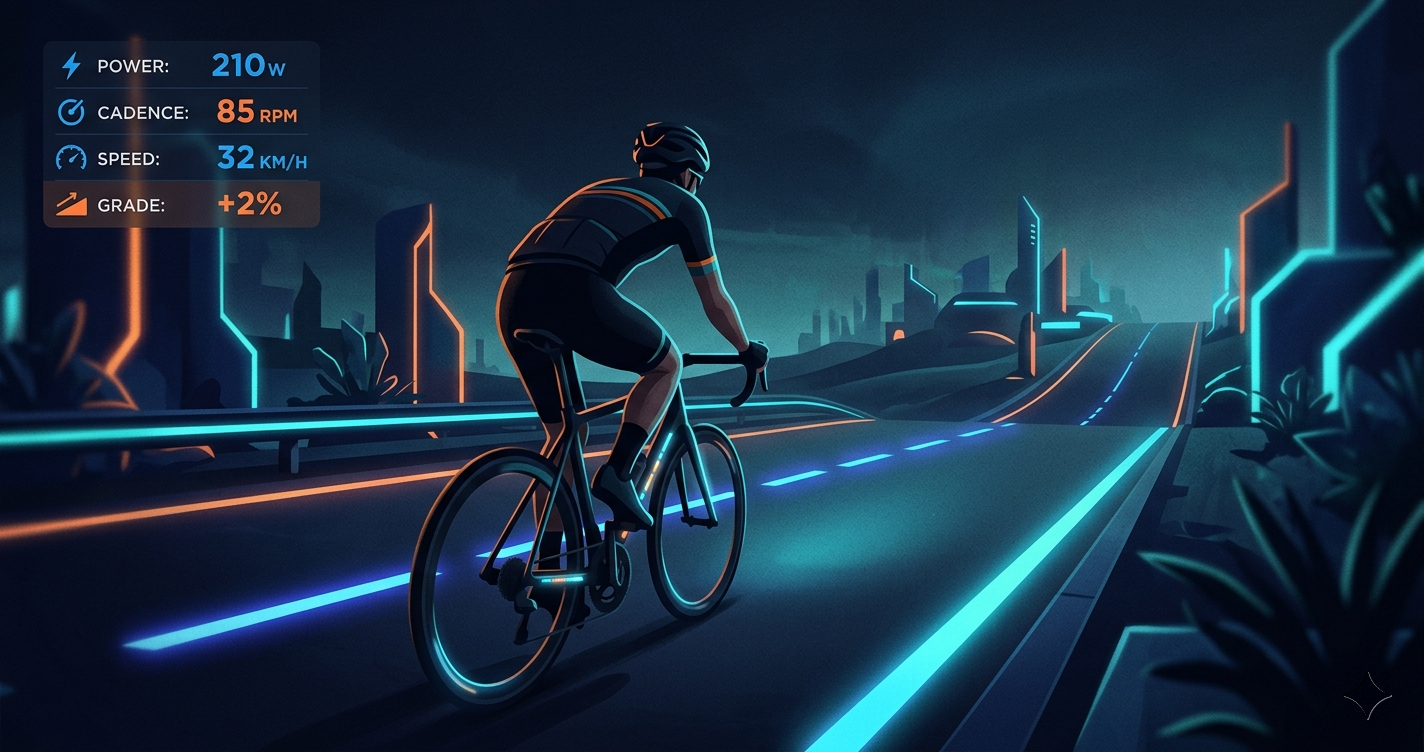
You're sitting comfortably on a RoboPacer's wheel, holding a steady effort, when suddenly the gap opens. The pacer pulls away and you're scrambling to close it. You didn't back off. Nothing changed on your end. So what happened?
Ask in any Zwift community and you'll hear the same word: surge. Riders describe RoboPacers as surging every twenty minutes or so, independently of terrain, following some hidden timer baked into the game. It's one of the most persistent complaints in Zwift forums and Facebook groups.
There's no hidden timer. But the real explanation is worth knowing, because it changes how you ride.
What RoboPacers actually do
A RoboPacer's power output isn't fixed at its W/kg rating at all times. What's fixed is the target — the steady-state effort it aims for on flat ground. What changes that output is gradient.
When a RoboPacer hits a rise, even a gentle one, it puts out more watts to maintain its speed. When it crests and starts descending, those watts drop. It doesn't ease off on climbs the way a tired human might — it just responds to the terrain, the same as any rider subject to Zwift's physics engine.
Eric Schlange of ZwiftInsider.com was direct about this when it came up in the Zwift Beginners community: "Their power definitely only changes due to gradient changes." No backend surge template, no timer, no periodic acceleration burst. Beyond the pacer's physical characteristics, its power output, and its bike, there's nothing else driving its behaviour.
So why does it feel like a surge?
Several things conspire against you here.
Zwift's terrain is more subtle than it looks. Gradient changes on many routes are small and frequent enough that you don't consciously register them as climbs. A 1–2% rise barely reads as uphill, but it's enough to bump the pacer's output and close the gap between your steady effort and what's actually needed to stay on the wheel.
Your power fluctuates naturally. A RoboPacer holds its calculated output with machine consistency. Humans ride in small surges — a little more through a corner, a little less when distracted. When the terrain ticks up even slightly, you're chasing a number that just got harder to hit while your own output may have drifted down a touch.
Pack dynamics add to it. In a larger group, the pacer can appear to accelerate because of how Zwift handles virtual drafting and group physics. If the pack stretches and the pacer gets pulled forward by the group's momentum, riders at the back feel it as a sudden jump, even though the pacer's power hasn't changed.
And confirmation bias does the rest. Once you've been dropped once, you're primed to notice every gap. A brief lapse in your own power — a moment's distraction, a slightly slow reaction — reads as a surge from the pacer rather than a dip from you.
What about riders who are certain they've measured it?
There's a grain of truth buried here, which is probably why the belief is so persistent.
Earlier versions of Zwift's Pack Dynamics system had known issues when pacers running older code templates encountered updated group physics. The result was genuinely erratic behaviour: bots accelerating unexpectedly at route intersections, power spikes that didn't match the terrain. Riders who were on Zwift during that period have a legitimate memory of RoboPacers doing something unpredictable.
That behaviour was fixed. But it planted a belief that became self-reinforcing: riders look for surges, find moments that feel like surges, and the myth carries on.
How to use this on the bike
If the pacer responds to gradient rather than a timer, you can anticipate rather than react.
Watch the road ahead. When you see a slight rise coming, add a little power before the pacer pulls away rather than chasing it after. The gap that opens on a gentle climb closes much faster if you never let it open in the first place. On descents, ease off — the pacer will slow as the gradient tips downward.
The Flat vs. Climb post goes into detail on exactly how much your required watts change with terrain for each RoboPacer. Worth reading if you want to put numbers to what you're feeling.